

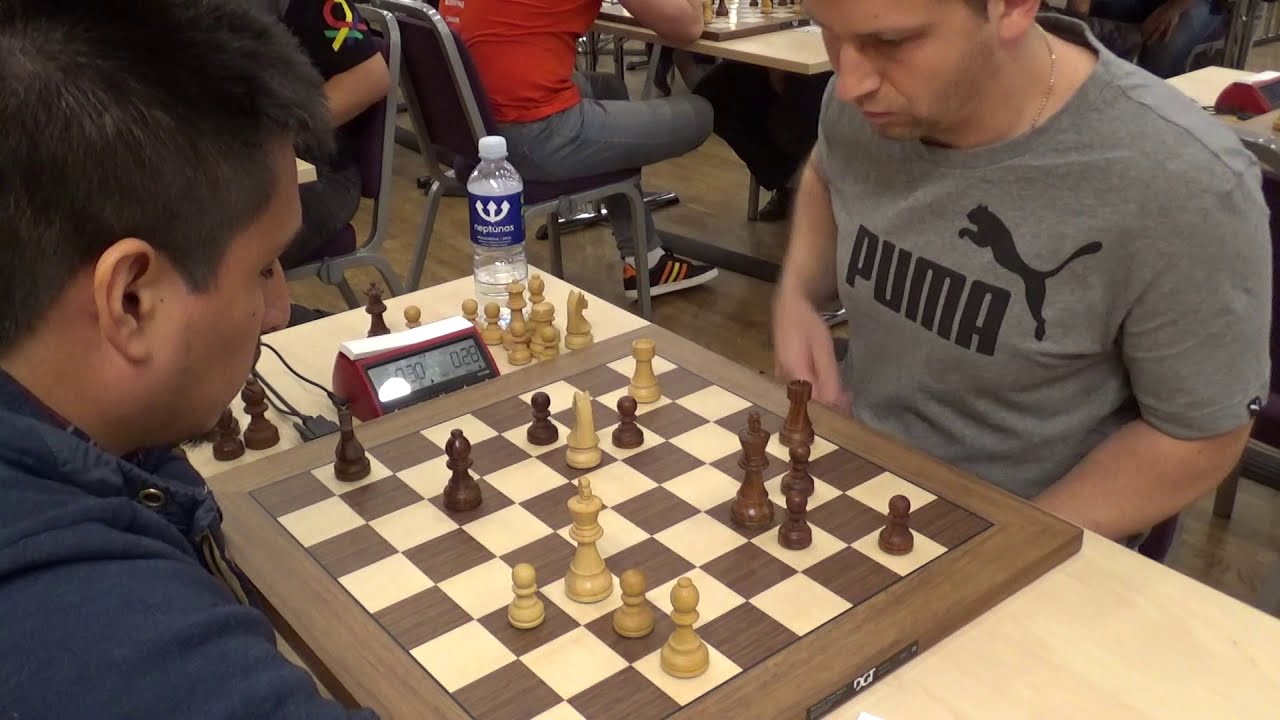
 Mikhail Tal blitz chess memorial, Riga, 2019
 #englishopening #andreivolokitin #blitzchess
Blitz chess and rapid chess video. Live blitz and rapid chess.
Rapid chess and blitz chess tournaments
Back-and-forth English opening: GM Cruz - GM Volokitin, Tal memorial blitz chess
There are several reasons to play the English Opening:
First of all, the English Opening is considered to be one of the most successful openings. That means by playing it, you are automatically maximizing your winning chances statistically.
Secondly, playing the English Opening can be a vital alternative for all 1.e4- and 1.d4-players who are tired of repeatedly entering the highly theoretical terrain of all the main lines Black can choose from.
Thirdly, the English opening leads to plenty of unforced variations. Direct contact between the pieces is often delayed in the opening and both sides often have a wide range of moves. Therefore, White can avoid premature simplifications, keep many pieces on the board and go for the full point.
Moreover, the English is fairly flexible and enables you to become a very versatile player. You can often transpose into other openings like the 1.d4-complex or the Reti Opening (1.Nf3). That said, you can start building your White repertoire by playing the English Opening exclusively and adding more and more variations step-by-step.
If you’re a 1.d4 player, the English Opening allows you to avoid a lot of unpleasant lines like the Slav Defense, the Nimzo-Indian or the Grunfeld Defense.
Thanks to the theoretical developments over the last years, the English Opening definitely carries a lot of theoretical bite in many lines. It is a common occurrence that club players try to develop naturally against the English Opening and soon find themselves in a strategically lost position. They lose the game without even understanding why they lost.
The English Opening is an opening which has been successfully used by the greatest players in the most important games in their life. Think of Garry Kasparov’s World Championship Match against Anatoly Karpov in 1987, where he had to win the last round with White in order not to lose his title. Think of Bobby Fischer who played it in the famous game six of his World Championship Match with Boris Spassky in 1972. Both Garry Kasparov and Bobby Fischer won these key games.
Blitz chess (also known as speed or fast chess) is a type of chess in which each player is given less time to consider their moves than normal tournament time controls allow. Openings, tactics and strategy are same.
1. c4 g6 2. g3 Bg7 3. Bg2 c6 4. e4 d6 5. d4 Nf6 6. Nc3 O-O 7. Nge2 e5 8. O-O Nbd7 9. h3 Re8 10. Re1 exd4 11. Nxd4 Qb6 12. Nb3 Ne5 13. Qxd6 Bxh3 14. Be3 Nxc4 15. Bxb6 Nxd6 16. Bxh3 axb6 17. e5 Nc4 18. exf6 Bxf6 19. Rad1 Nxb2 20. Rxe8+ Rxe8 21. Rc1 Nd3 22. Rc2 Re1+ 23. Kh2 Nb4 24. Rd2 Bxc3 25. Rd8+ Kg7 26. Rd7 Re2 27. Kg2 Nxa2 28. Rxb7 b5 29. Nc5 Kf6 30. Kf3 Re8 31. Ne4+ Rxe4 32. Kxe4 Nb4 33. Bf1 h5 34. Rb6 Ke7 35. Rb7+ Ke6 36. f4 f5+ 37. Kf3 Nd5 38. Bd3 Bd4 39. Rb8 Ne7 40. Bb1 Kd6 41. Rd8+ Kc5 42. Rd7 Bf6 43. Ba2 b4 44. Bb3 Nd5 45. Rf7 Bd4 46. Rf8 Nc7 47. Rg8 Nb5 48. Rxg6 Bc3 49. Ba4 b3 50. Kf2 b2 51. Bc2 Na3 52. Bxf5 b1=Q 53. Bxb1 Nxb1 54. Rg5+ Kd6 55. Rxh5 c5 56. g4 Nd2 57. g5 c4 58. Ke3 Nf1+ 59. Kf2 Nd2 60. Ke3 Nf1+ 61. Kf2 Nd2 62. g6 Bd4+ 63. Ke2 c3 64. Rh7 Nb3 65. g7 Bxg7 66. Rxg7 c2 67. Rg1 c1=Q 68. Rxc1 Nxc1+
Tournament organized with support of Coca-Cola company, Rietumu Bank, Tolmets, Latvijas Balzams.

![Древнеегипетский портрет [Семь дней истории]](https://lh3.googleusercontent.com/blogger_img_proxy/AEn0k_sFpTJj2FRZ641mCJMXYo-O22EECQxWMeSeNy003uZNyO5E40oEd2-pQnAbj7gPU4ngpJHzmjXfiaqjO9obXX69w_VkWIVi0KHt6FNKkx1ADGqQrA=w680)


0 Comments